Monday, 24 March 2014

Bad Hare Day

Last week I was snowed under by revision for my Biology ISA exam, so I didn't get a chance to post a new blog. As fascinating as doing an investigation into leaf sizes on different parts of a tree is, I relished the opportunity to get out looking for wildlife again when I had some spare time on the weekend.

I began at our local airfield, looking for Mad March Hares. It had been a couple of years since I last tried to film Hares boxing, and I was quickly reminded of how difficult it is to do so. Hares dig small impressions in the ground called 'forms', which they can lie in for many hours during the day. This excellent camouflage is good for the Hares-which just look like clumps of earth on the ground- but bad for anyone trying to spot them. 

But spotting hares is only half the battle- it's keeping up with them which is the real difficulty! Hares can run at speeds of up to 70 km/h, so once spooked shoot off into the distance, well beyond the zoom of my camera. As a result I have to sneak up on a group of Hares very slowly and very quietly (with ears like those it's no wonder they have excellent hearing), and only after half an hour of silent shuffling was I able to get close enough to get a few shots of this pair: 


Unfortunately I didn't see any boxing, but then I wasn't there for very long. Though with all the spare time I have on my hands this week, I hope to go up to the airfield as often as I can, so fingers crossed I'll catch them boxing then. 

Yesterday I rescued my first fledgling of the year. It was a young Collared Dove, found between two ferns at a local garden centre. Usually with fledglings found on the ground, the advice is to leave well alone. Young birds will often fall out of the nest before they can fly, but their parents will still come down to feed them, so long as it is safe to do so. The best thing to do is to watch the bird for a while to see if its parents come down to it, and place it out of reach of predators, such as cats, if needs be. 

However, on some occasions it is necessary to intervene. Yesterday was such an occasion, as one of the Dove's parents was confirmed dead (it's body had been found the day before), and the other was nowhere to be seen. The Dove was also very small, even for a bird of it's age, and its bony keel and empty crop suggested to me that it might not have been fed for some time. With this in mind, the decision was made to take it to Tiggywinkles Wildlife Hospital. 

Found between two ferns, our first fledgling of the year!
Now that we've had our first fledgling, I'm sure there will be many more to come!


Monday, 10 March 2014

Prickly Encounters

The fantastic article on Hedgehogs in this month's BBC Wildlife Magazine has got me thinking about some of the prickly encounters I've had with the nation's wildlife icon...

I think the first time I ever saw a Hedgehog in the flesh must have been when I was about six years old. It had spent an afternoon wandering around my garden, curling into a ball whenever we approached it before disappearing underneath the neighbours' fence. In hindsight, the fact that the Hedgehog was out during the day means it was probably quite ill, and really we should have taken it to a wildlife hospital. That's a mistake which I'll never make again, having rescued a number of Hedgehogs since setting up my own wildlife ambulance service, Oakley Animal Rescue, back in 2010.


This Hedgehog, found out during the day, had a tick attached to its right eye
By far the majority of Hedgehogs I have rescued since then have been found out during the day (ODD). There are many reasons why a Hedgehog might decide 'to go ODD'. For example, if a 'hog has not built up enough fat to see it through the winter, it will have to fill up it's days (as well as it's nights) with extra foraging in a desperate attempt to put on some more weight before hibernation. 

This was the case with the very first Hedgehog I dealt with; a scrawny animal we affectionately named 'Henry', who was so small he could fit quite neatly into an outstretched hand. After being placed in a box with some straw to nestle under, Henry was rushed off to St. Tiggywinkles Wildlife Hospital where he spent the winter in comfort.


An underweight hedgehog will need to be fed up in a hospital to stand any chance of surviving the winter
Heatstroke may also cause a Hedgehog 'to go ODD'. You might not expect to find a heat-stricken Hedgehog on an autumnal October afternoon, yet this is exactly what happened in 2011 when a freak heatwave brought temperatures of 29 °C to the south-east of England. 

The 'hog in question was found flat out on a pavement, so severely dehydrated that it was unable to even curl itself into a ball once it had been scooped up off the sizzling floor. Worried that it might not even survive the journey to Tiggywinkles, we quickly wrapped it up in a a wet towel and offered it oral rehydration solution. It soon perked up, and could safely be transported to the hospital for further treatment. 
This heat-stricken hedgehog perked up after being wrapped in a wet towel and given rehydration solution
My favourite experience with Hedgehogs so far was at Secret World Wildlife Rescue last summer. During the week I spent there I got the chance to take care of more Hedgehogs than I could shake a stick at. These unfortunate animals were in for all sorts of reasons, from being sprayed bright green with fence paint to being poisoned by slug pellets. Nothing was more exciting though than hand-feeding a litter of orphaned hoglets, whose very survival depended solely on the dedicated team of volunteers that work at the hospital.

Rescuing Hedgehogs has brought me much closer to an animal which I otherwise would probably never see. I strongly urge anyone with a passion for wildlife to help out at their local rescue centre, and make a real difference to the animals on their local patch. 


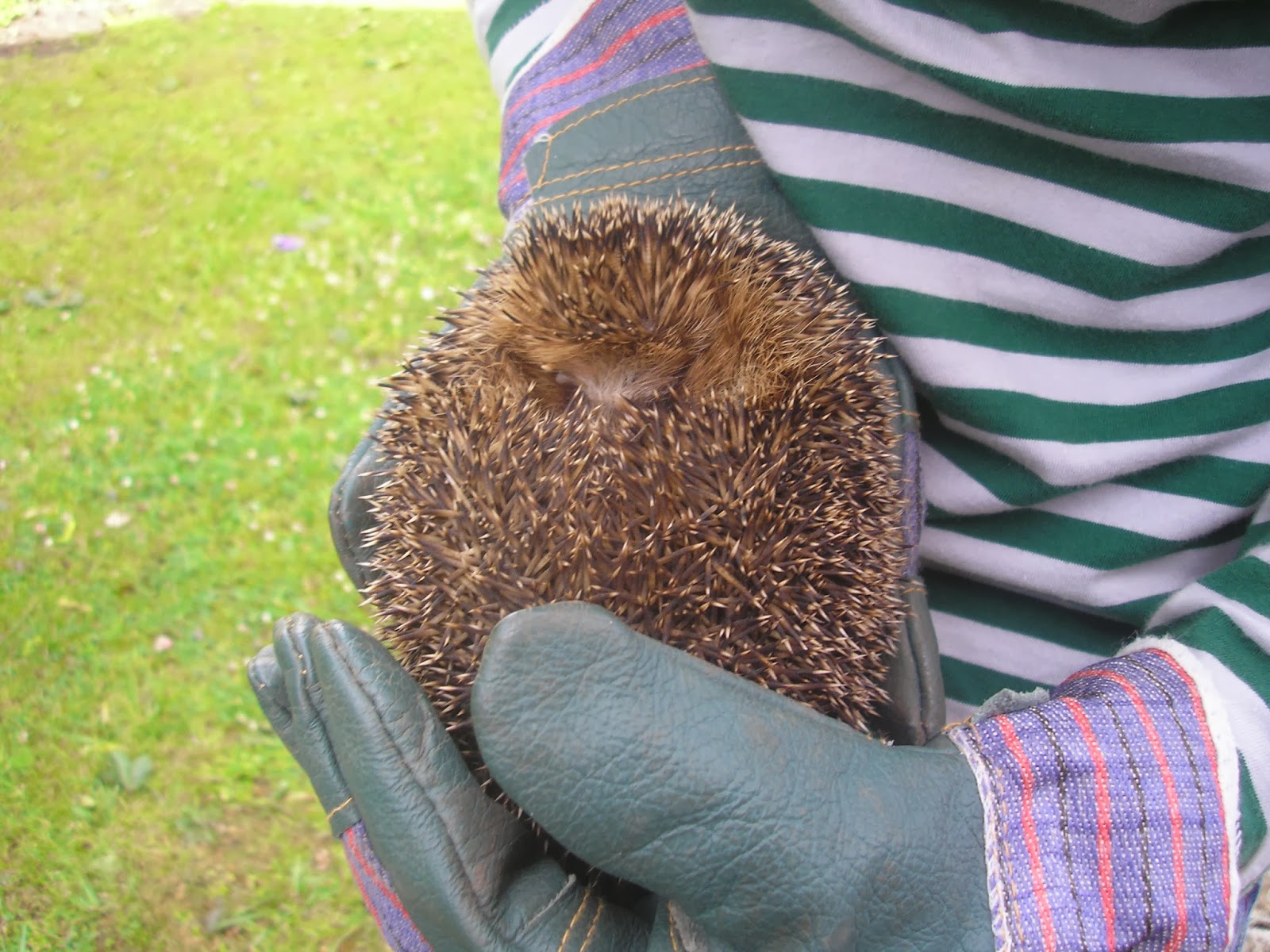
Always wear gloves when handling Hedgehogs
My top tips for rescuing Hedgehogs:

1. If you see a Hedgehog out during the day, it needs your help!
Many animals (such as young birds and deer) may appear to be in danger when in actual fact they are not, and taking them to a wildlife hospital unnecessarily can actually be detrimental to their well-being. This is not the case with Hedgehogs, and any found out during the day will almost certainly be sick. So if you do come across one which is ODD, get it to a wildlife rescue centre to be assessed straight away! Even if it turns out to have nothing wrong with it, it is always better to be safe than sorry, and the Hedgehog can always be returned to where it was found once it has been given the all clear.

2. Handle with Care
Hedgehogs don't have those prickly spines for no reason! Always use thick gloves when handling them to avoid hurting you hands.

3. Never release an entangled Hedgehog
Hedgehogs often find themselves entwined in netting, chain links and all manner of rubbish that we leave lying around in our parks and gardens. If the trapped casualty is cut free from a ligature immediately, a condition called pressure necrosis may arise which can kill the injured Hedgehog. So always take the casualty to a rescue centre with any netting, rubbish, etc, still attached!  

4. Be wary of diseases
Like many animals, Hedgehogs can harbour a variety of diseases which can be passed to humans through direct contact. These include Salmonella, Leptospirosis (Weil's disease in Humans) and ringworm. To minimise the risk of catching an infectious disease, wear protective clothing (gloves, face masks, etc.), never touch any urine or faeces and always wash your hands after handling an animal.

5. Never underestimate a Hedgehog
Hedgehogs can run deceptively fast over short distances, even when injured. If the 'hog makes it to cover in low vegetation then you may very easily lose it, so be sure to block off all of it's escape routes before you attempt your rescue, and be prepared to throw a towel or jumper over it if it decides to flee. 

Happy Rescuing!

Wednesday, 5 March 2014

March Madness

March has arrived and with it Winter slowly seems to be slipping away as Spring begins to take hold. I've heard Skylarks singing, seen Robins collecting twigs for their nests, and admired the copious Snowdrops and Daffodils that have been popping up all over the village. Yesterday I even saw a bee!
Spring is on the way!
But as Winter fades away, there is one animal I'm particularly excited about filming this month: The European Hare. Hares are famous for the mania that consumes them at this time of year, as testosterone levels reach their peak in the male 'bucks'.

Unfortunately for the bucks, the female 'does' aren't always too keen on all the extra attention and will often rebuff the males' unwanted advances by lashing out violently with their fists- an act known as boxing. To further test the resolve of their senseless suitors, a doe will also challenge competing bucks to a race. She charges across the countryside at speeds of over 70 km/hour, and only the male that can keep up with her for longest (and hence the fittest) wins the right to mate with her.

Although the breeding season of European Hares lasts from January until August, in April testosterone levels in bucks start to decrease and their madness begins to subside, so this month is my best shot at filming this awesome behaviour. I've only ever filmed my local Hares boxing once, briefly, a few years ago. To film them do the same again this year would be a major wildlife aim of mine ticked off the list!

This morning I went back to the Badger sett to set up my trail cam again. The water in the flooded entrance to the sett had receded, and what's more a strong, musky, vulpine smell lingered in the air around it. Could it be that the Foxes have moved into the recently abandoned Badger sett, effectively switching homes with their mustelid neighbours? To find out I'm going to have to monitor the mound with my trail cam over the next few days, but I'll post an update on here as soon as anything new comes up. 

                 A clip of last year's Fox Cubs, shortly after they emerged from their den for the first time in April 2013

The Barn Owl still hasn't shown up, despite weeks of intensive searching. I'll be keeping an eye out for it over the next few months, but for this month at least I'm going to focus all my efforts on finding Mad March Hares.

Let the madness begin!

Billy

Monday, 24 February 2014

The Mystery Of The Missing Badgers

On the outskirts of the village there is a large mound of earth. It is not much to look at, and in the summer an eruption of nettles protects it from human intruders, but for at least the last three years now it has been shared by both a family of Foxes and a family of Badgers.

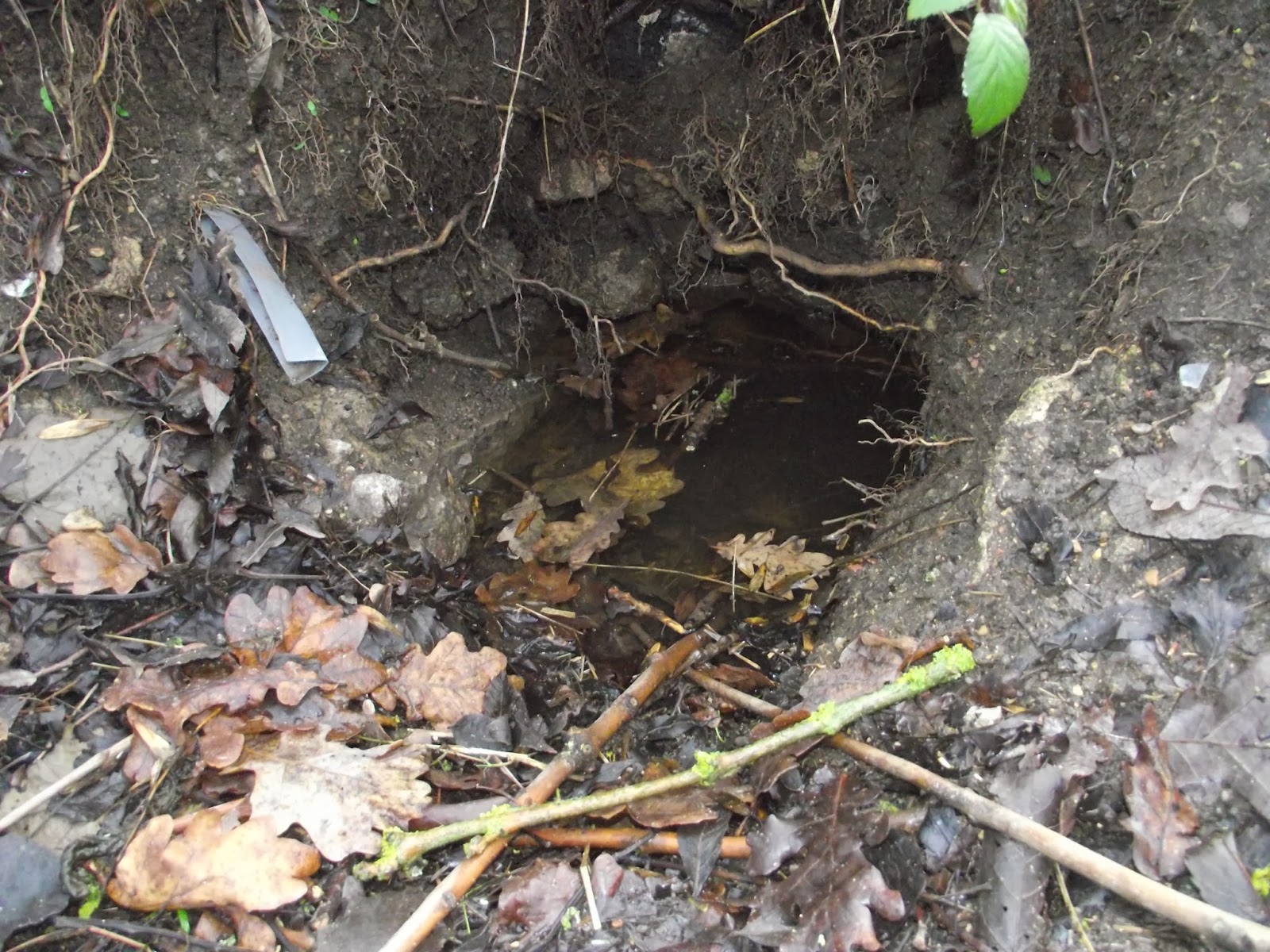
This year I assumed would be no different. However, on a recent visit to the mound I made a surprising discovery. The entrance to the Badger's sett, which at this time of year I would normally expect to find littered with the disheveled straw and bracken that made up their bedding over the winter, was bare and lifeless. There was no sign anything lived there at all. Upon closer inspection, the reason for this absence of Badger activity became woefully clear- the holes into their sett had flooded!


The entrances into the Badger sett were completely flooded!
So what had become of the Badgers? Strewn across the entrance to the den that is usually inhabited by a family of Foxes (on the other side of the mound) were the tell-tale scraps of straw that suggested somebody was home. With that in mind, I decided to set up my trail cam. Forty-three of the forty-four files it recorded that night were corrupted (I should really invest in some better equipment!), but the one video it did manage to store was enough to answer my question:


The mystery of the missing Badgers was solved! Having been flooded out of their own sett, probably soon after the storms started in January, they must have found their way into the Foxes' den which is only occupied while they raise their young. The chances are that the two chambers are connected by a subterranean network of tunnels, so it would have been very easy for them to do so. 

And with our local vixen probably looking to settle down to give birth sometime very soon, it remains to be seen whether she and her partner will move back into their old den to bring up their young alongside the Badgers (it has been known to happen), excavate a new one in some other part of the mound, or move somewhere else entirely. I will of course keep you posted on this as I find out more over the next few weeks. 

Meanwhile my search for a Barn Owl has continued to prove futile. Last week I went out every evening in search of the elusive bird, yet it was still nowhere to be seen. I even bumped into a couple of local wildlife photographers who were also looking for the owl, but they had had no luck either. This week I think I may have to go one step further, and start searching for the owl through the fields at night.

It's time to fix my head-torch!

Billy 


Monday, 17 February 2014

Big Schools' Birdwatch!

On Friday I helped a year 7 science class take part in the RSPB's 'Big Schools' Birdwatch'. For many of them it was the first time they had ever paid any attention to birds before, and once they had stopped giggling at the funny names members of the family Paridae are unfortunate enough to have, I was pleasantly surprised by the enthusiasm with which they took up the challenge.

To start with, each student was given their own bird to look out for and a tally chart to record how many they saw. Unfortunately the storms on Friday prevented us from seeing as many birds as we might have done, but those that did manage to identify their species were left buzzing by the experience (reminded me of something). 

Even those that didn't were still captivated by the few birds that we did see. They would all run to one window to see a Crow, then to the next window to see a Magpie. These were species that I'd probably overlook nowadays, but the astonishment the students showed for them has made me realise that perhaps I should pay more attention to the more familiar things out there. After all, there is no reason why a Sparrow should be any less interesting than a Sparrowhawk! And even if only one student has taken away from that lesson a greater appreciation for the natural world, this planet can only be a better place for it. 

The students were amazed as a small murmuration of starlings rippled over our heads on Friday 
This week I have also been stepping up my search for a Barn Owl. Seeing as this is my first month as a local patch reporter, I thought I'd set myself a bit of an easy 'wild challenge', safe in the knowledge that a Barn Owl can often be seen gliding across the fields next to my house in the evenings. Worryingly however, I have not seen the Owl once this year so far. 

Barn Owls have been doing very badly these past four years, undermined by continuous bouts of extreme weather. It is estimated that as few as 1,000 breeding pairs still remain in England, so to lose the one in the fields next to my house would be another devastating blow to a species in serious decline.

Let's hope my search proves more fruitful in the coming weeks!

Billy


Monday, 10 February 2014

Welcome to Filming Foxes!

People always laugh when I tell them how I became interested in wildlife. You see the truth is, I’d be a very different person today had a certain bird book not fallen on my head when I was 12....

I was searching for a DVD under my brother’s desk when the small green field guide found its fateful way to my face. On the front cover was a bird unlike anything I’d ever seen before. It was colourful, with a bright red face and yellow wing bars, and striking white spots along its jet black wings. For all I knew it could have been some exotic bird of paradise. And what's more, it was sitting in a tree right outside the window!

A sunset through the lens of my first video camera

I quickly skipped through the pages of the field guide until I came across an image of the mesmerising bird: a Goldfinch! I had made my first ever identification. The buzz it gave me was like nothing I had ever felt before; a buzz that I have been hooked on ever since. It has driven me to take up filming wildlife so that I can keep a record of my encounters forever, and share them with other people.


It has also driven me to start up a wildlife rescue organisation, called Oakley Animal Rescue, which responds to wildlife casualties in the local area. Over the past four years we have rescued countless wild animals, from Pipistrelle bats to Muntjac, and have become very well known for our work in the community. I will post more about O.A.R over the coming months.

'Jim' the Blackbird was rescued after he fell foul of a cat in 2012

Thankfully, I have a local patch that is brimming with nature to fuel my passion for wildlife. Nestled in the quiet Buckinghamshire countryside, my small village is home to a plethora of species which I am lucky enough to encounter on a daily basis.    


For example, not too far from my house is a mound of earth shared by Foxes and Badgers who have cubs every spring. I hope to film these for you later this year. And being quite close to the Chilterns, I am reminded of the success of a certain reintroduction programme every day as I see Red Kites gliding over the rooftops outside my bedroom window. Last year a pair nested in the village,so it would be nice to see them do the same again this spring.

A Red Fox (Vulpes vulpes) has a yawn in the shade

Just outside of the village there is a very large forest which is home to Fallow, Roe and Muntjac Deer, as well as, Adders, Sparrowhawks, Buzzards and all sorts of Butterflies in the summer. We are also fortunate enough to have an old WW2 airfield very near us which has become a haven for wildlife. Birds such as Skylarks love it there, and it’s a great place to see Hares boxing in March!


I hope to bring you all this wildlife and much more in my blogs throughout the year. I’ll also be setting myself a ‘Wild Challenge’ every month. This month: To film a Barn Owl hunting!


Wish me luck!


Billy